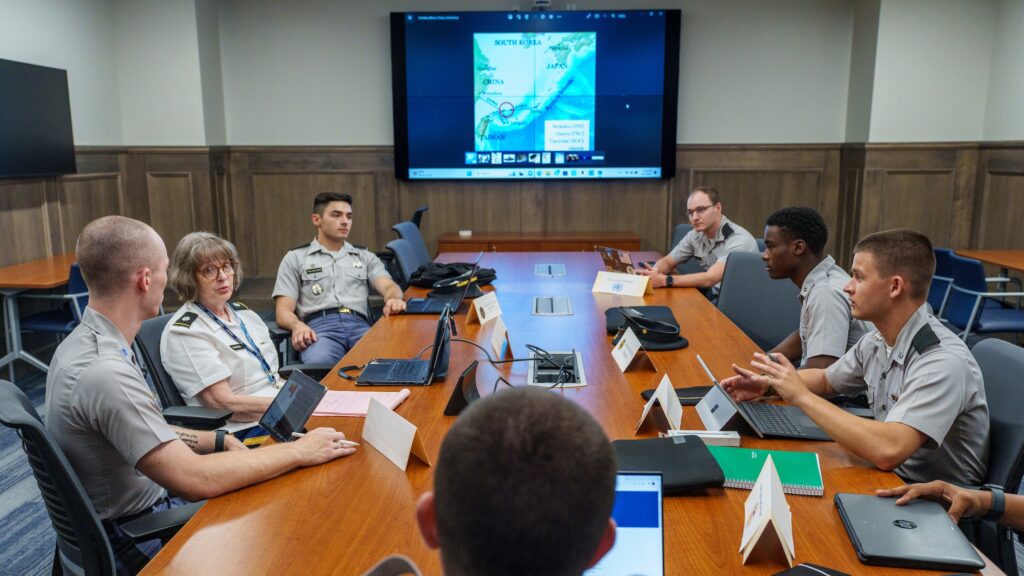
Photo: Cadets using the training SCIF in Capers Hall
The Citadel receives $250K grant for Intelligence Futures and Judgment Lab
Cadets and students in The Citadel’s Intelligence and Security Studies will soon have more opportunities to make difficult decisions under pressure — and, sometimes, to make the wrong one.
That space to fail is part of the training: a feature, not a bug.
A new $250,000 federal grant from the Department of War will establish the Intelligence Futures and Judgment Lab, expanding The Citadel’s use of wargaming to help students practice decision-making involving complex national security scenarios in a simulated setting, before the consequences are real.
“This is a rehearsal for judgment,” said Melissa Graves, Ph.D., an associate professor and the head of the Department of Intelligence and Security Studies. “This is you being put in a tight spot, but it’s not go-time.”
The lab itself is not a physical room. Instead, the exercises are designed to give students practice making high-stakes decisions, especially when circumstances are less than ideal.
“It’s a lab for you to explore decision-making and to explore what it feels like in a situation where you don’t have enough resources, you don’t have enough time and you owe someone a decision 10 minutes ago,” Graves said.
The federal grant will allow The Citadel to build on years of wargaming work by adding the people, programming and technology needed to expand it. That includes a dedicated director of wargames, support for The Citadel’s annual Day of Intrigue exercise and a fellows program that will pair government participants with those who work in the private sector.
The funding will also provide key software that can help faculty capture and analyze decisions made during the simulations.
The Citadel has incorporated wargaming into its curriculum since at least 2017, most often with its Day of Intrigue event.
The annual exercise often runs one or two days, placing cadets and students into fictionalized but timely national security scenarios alongside practitioners from the intelligence community. The last exercise in April explored cartel activity in Latin America.
With this federal grant, faculty plan to weave wargaming more deeply into the intelligence curriculum, allowing cadets to encounter simulations throughout their four years rather than only near the end of their studies.
“Our exciting new partnership with the Department of War and SOLIC is a big step forward in preparing the next generation of principled leaders,” said Brian Maddison Jones, dean of the School of Humanities and Social Sciences. “It’s a dynamic and substantive experiential learning opportunity for all our cadets, and I’m thrilled that their efforts will help strengthen national security. Most importantly, the Futures Lab will demonstrate just how critical human judgment is in the age of Artificial Intelligence and showcases how the humanities and social sciences prepare students to thrive in this challenging space.”
One recent exercise helped crystallize the need for the new lab, and illustrates why the U.S. government is also interested in supporting the effort.
In a 2025 war game, which centered on Taiwan and the global semiconductor industry, organizers created separate U.S. government and private-sector teams and expected the two to work closely together as the crisis unfolded.
Instead, the private-sector team defected, set up a fictional enclave in Switzerland and broke with the U.S. government, ultimately declaring itself independent and demanding its own seat at the table alongside national governments.
The move was fictional, but the tensions it exposed between the private sector and government were not.
The simulation revealed a divergence between the two groups and raised larger questions about how institutions with different cultures, responsibilities and speeds of decision-making might respond during a crisis, whether it’s a scenario involving sophisticated computer chips or a more common occurrence, like a hurricane battering the Eastern seaboard.
That experience helped prompt faculty to propose a more sustained effort examining what Graves called the “public-private seam.”
Government, she noted, often moves slowly and deliberately by design, while technology companies can move at dramatically faster speeds.
As the two become increasingly intertwined in national security, understanding that friction — and learning how to navigate it — will become increasingly important.
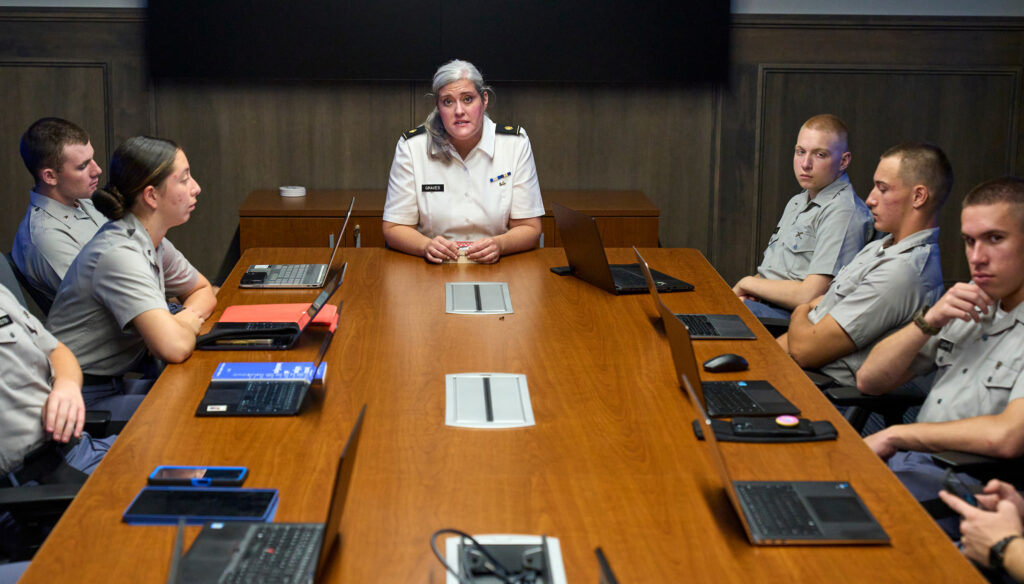
At The Citadel, wargaming offers a way to experience those challenges rather than simply hear about them in a classroom. Graves said she has also seen students walk out of wargaming with job offers, after outside participants saw how they could rise to the challenge.
“It’s one thing to stand up and lecture about the largest semiconductor manufacturer and the problems of Taiwan,” Graves said. “It’s another thing to put them in the middle of a problem and say, ‘Something has happened and you have to decide what your team or your agency is going to do in terms of a response.’”
New technology could also make those exercises more useful as teaching and assessment tools. Faculty are exploring software that can capture decisions across multiple teams during fast-moving simulations, allowing them to later examine how one choice influenced another and potentially track how cadets’ decision-making develops over four years.
But the goal is not to replace human judgment with technology.
Instead, Graves said, the technology can free faculty from some of the mechanics of running a simulation and give them more time to mentor students, engage with participants and examine the decisions being made.
The stakes of those lessons are increasingly clear as artificial intelligence, cyber threats and other technologies evolve.
For researchers and students alike, the ability to look back at critical decision points – and even smaller choices that cascaded into something unexpected – could be invaluable, Graves said.
“We’re investing in our students as people and teaching them to be ahead of the technology, to be fluent with it,” Graves said. “But then know, at the end of the day, the decision rests on you.”
The Department of Intelligence and Security Studies plans to hold its next full in-house wargaming exercise in the spring.
 The Citadel in Photos: 9/11 remembrances, Gen. McKenzie’s inauguration and more from September 2026
 ‘I will be relentless’: Gen. Frank McKenzie inaugurated as The Citadel’s 21st president
 For the third consecutive year, The Citadel named #1 Regional University in the South by U.S. News & World Report