When Cadet Khloe Krome was a child, she dreamed of helping others. There are two pictures to prove it.
In one photograph, Krome wears a little white coat and a plastic blue-and-gray stethoscope around her neck. A face mask covers her nose and mouth, but her twinkling blue eyes give her smile away.
In another, she wears a white tulle dress with a bright pink flower clip nestled in her shoulder-length blond hair. Grinning, she points to a piece of paper bearing the prompt: “My dream is to be…” She was 6 years old. She filled in the blank. “A missionary baby doctor who plays music for her pashins because I want to help people.”
She couldn’t yet spell “patients.” But Krome already knew why she wanted to care for them.
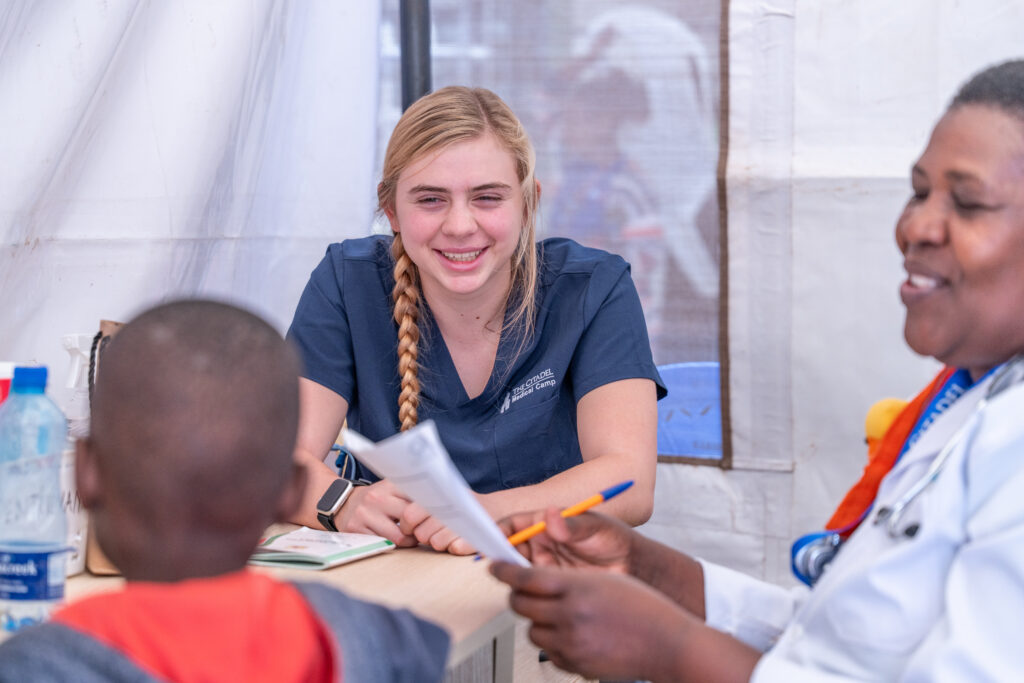
This summer, Krome, ’28, took her dream across the globe to the slums of Nairobi, Kenya in a one-of-a-kind study abroad program offered by The Citadel, the Military College of South Carolina.
Those three weeks not only affirmed her purpose, it set her future into motion. Krome now plans to graduate early and has already been accepted into medical school. Today, her goal of becoming a neonatal intensive care unit (NICU) doctor feels more within her grasp than ever.
As she put it in her reflection essay: “It forever reoriented my perspective, pushed me out of my comfort zone and inspired me.”
Months later, Krome said her experiences in Kenya are ones that she expects will stay with her forever.
“Being able to go there and see how you can truly help people,” she said, pausing for a moment before continuing. “It definitely cemented my passion for medicine.”
The program brings students into a setting where they can learn about health care, engage with local communities and see how medical care is delivered in a different part of the world.
Led by Health and Human Performance professors Sarah Imam, M.D., and Kimbo Yee, Ph.D., the program has been recognized by Kenya’s Ministry of Health as the largest free general medicine provider in the region.
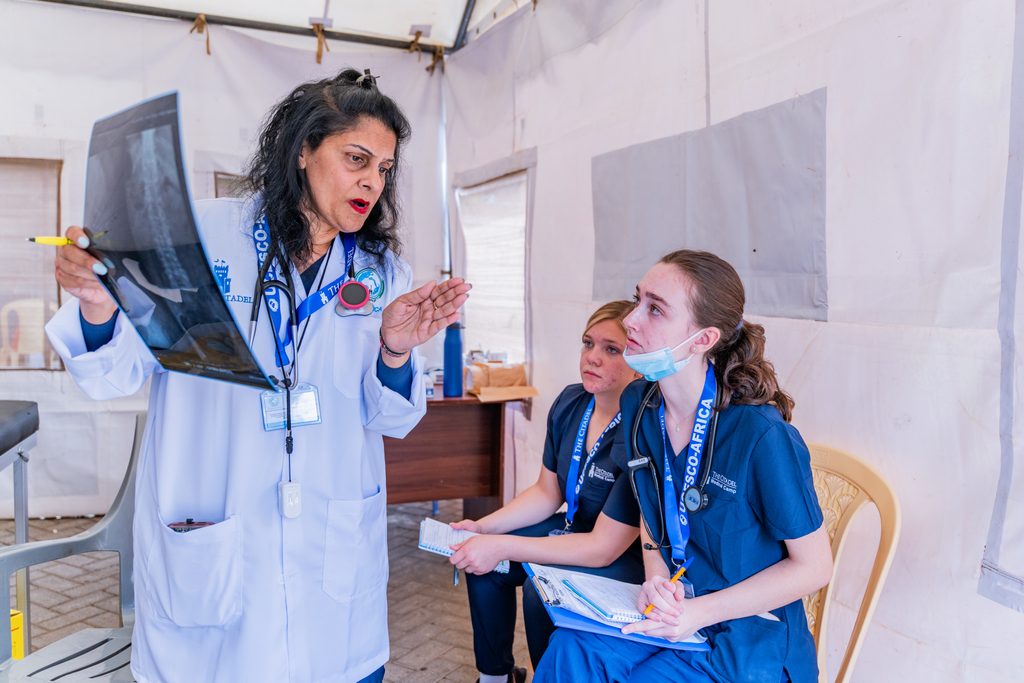
Imam, who came to The Citadel in 2015 from the Medical University of South Carolina, is the driving force behind this one-of-a-kind study abroad program. With the help of Mr. and Mrs. David C. Swain Jr., ’80, and Dr. and Mrs. Christopher C. Swain, ’81, Imam took 29 students and faculty in the summer of 2022 to the slums of Nairobi, Kenya (opens in a new tab), where they treated more than 5,000 patients in three weeks.
The City of Charleston has also applauded these international efforts three years ago with a formal commendation praising The Citadel’s leaders and students for “their remarkable efforts to assist populations in need.”
Now in its fifth year, this program has continued to build on that legacy as Krome and 16 other students spent three weeks last summer operating The Citadel’s medical camp in Kenya. During that time, they served 15,023 patients, the highest number in the program’s history, Imam said.
“No one deserves to be sick. No one deserves to not get medical care,” Imam said. “I think that everyone’s attitudes change once they’re there, and they truly become caring. I’m hoping that is what they will take with them when they go on to become health professionals themselves, that empathy.”
Students worked alongside 20 doctors from different specialties that included general medicine, pediatrics, orthopedics, ophthalmology, obstetrics and genecology, as well as dermatology and ear, nose and throat specialists.
The students were not mere observers.
They collaborated with local doctors and nurses, assisted with clinical operations, conducted physical exams under supervision, and gained hands-on healthcare and community health experience not typically available at the undergraduate level in the United States.
“They actually get to take patient history and do a physical exam, and that is really pretty advanced,” Imam said. “I think the most important thing is it’s a journey of discovery for the students, and they get to know what they like and enjoy.
“We quite often have students coming in for one thing and suddenly discovering ‘I want to do this instead,’ and that, to me, is a beautiful thing.”
Cadet William “Russ” Schaper, ’27, was drawn to the program in part by his own story.
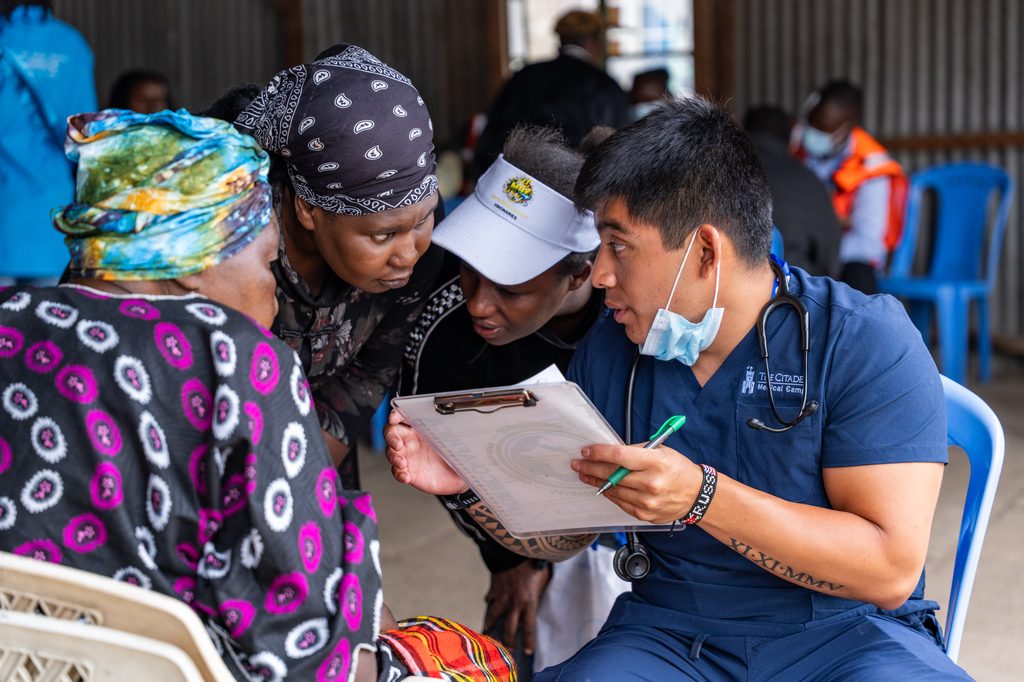
Adopted from Guatemala, he said he wanted to gain another perspective on life in a different part of the world. The experience proved eye-opening, particularly when the Army contract returned to the United States and went directly to training at Fort Knox.
“I remember just kind of thinking to myself that a lot of people are complaining here, and I’d be lying if I said I wasn’t complaining a little bit, too. But at the same time, coming off of what I’ve just seen and what I’ve just done in conjunction with others in Kenya it was just — I felt bad complaining,” he said. “I had nothing to complain about.”
As an exercise science major, Schaper also had the opportunity to put his classroom learning into practice. He worked in physical therapy, triage and other areas of the camp, helping assess patients with a range of needs, from young children to older adults.
The experience challenged him to adapt his approach, particularly in a setting with fewer resources and less equipment than he was accustomed to in the United States.
“You spend all this time in the classroom,” he said. “It’s like, okay, good. It was pretty cool. I’m kind of doing it. And you go over here, and it’s now I’m actually doing it.”
The experience also gave Schaper a new appreciation for the role of leadership and service in his education. He said the camp stood out among study-abroad opportunities because students were not simply learning about another country. They were taking responsibility and putting the values they are taught at The Citadel into practice.
“Here at the school, we preach so much about leadership, and being a servant leader,” he said. “With this study abroad program, it’s really all about leadership, and you can see that in everyone. It’s not just a couple words on a piece of paper or a banner that says ‘leadership.’ You’re actually doing leadership. You know you’re taking a step up in an environment that you don’t know too much about.”
Imam said she also saw how leadership became a shared value in camp life.
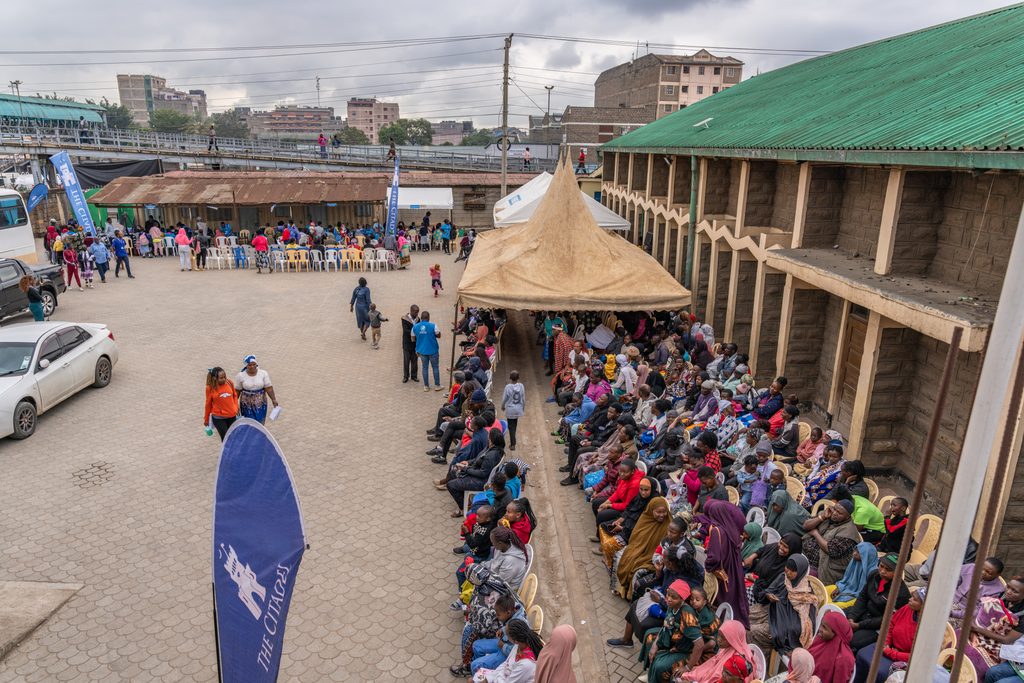
“They’re learning global leadership,” she said. “The students very quickly learn that this is our camp. You see something wrong? If you can fix it, fix it.”
The camp’s impact also changed lives. This summer, a local eye hospital partnered with the program to examine patients and provide treatment.
The Citadel Medical Camp funded 132 sight-restoring surgeries, including procedures for cataracts and other conditions affecting vision. Students were permitted to observe in the operating room, seeing patients they had encountered at the camp receive treatment.
The program also expanded the medical supplies it could provide, distributing wheelchairs, crutches, back braces, neck braces, knee supports, wrist supports and compression socks to patients who needed them. In addition, some 800 medical-grade glasses were distributed.
Imam said the humanity of their work and treating patients with dignity and respect was always at the center of their work.
Schaper recalled one patient in particular that impacted him: a girl he believed was about 6 years old who had suffered a head injury several years earlier. The injury caused a brain bleed and left her without movement or function in her right arm.
The encounter brought into focus how an injury or medical condition left untreated can have lasting consequences, particularly when access to specialists, equipment and follow-up care is limited. Conditions that might be addressed quickly in the United States, Schaper observed, can become lifelong problems elsewhere.
The experience in Kenya also reinforced the importance of humility, adaptability and recognizing that helping others sometimes means understanding the limits of what you can provide.
He said the program gave him a deeper appreciation for the importance of understanding and respecting different cultures.
“It’s very important to be yourself, but at the same time, it’s very important to stay conscious of respect,” Schaper said.
For someone who hopes to pursue a career in the infantry, that lesson carries particular weight for Schaper.
Working alongside people from different backgrounds and cultures requires more than the ability to adapt to unfamiliar circumstances. It requires an understanding of the people around you, an openness to different perspectives and the ability to build trust through respect.
“You don’t know really anything about it until you do it, and being comfortable while you’re uncomfortable is probably one of the best things you can learn pick up at an early age because life isn’t comfortable,” he said. “Life isn’t gonna patty cake you all the way. Nothing really gets easier; you just get better at it.”
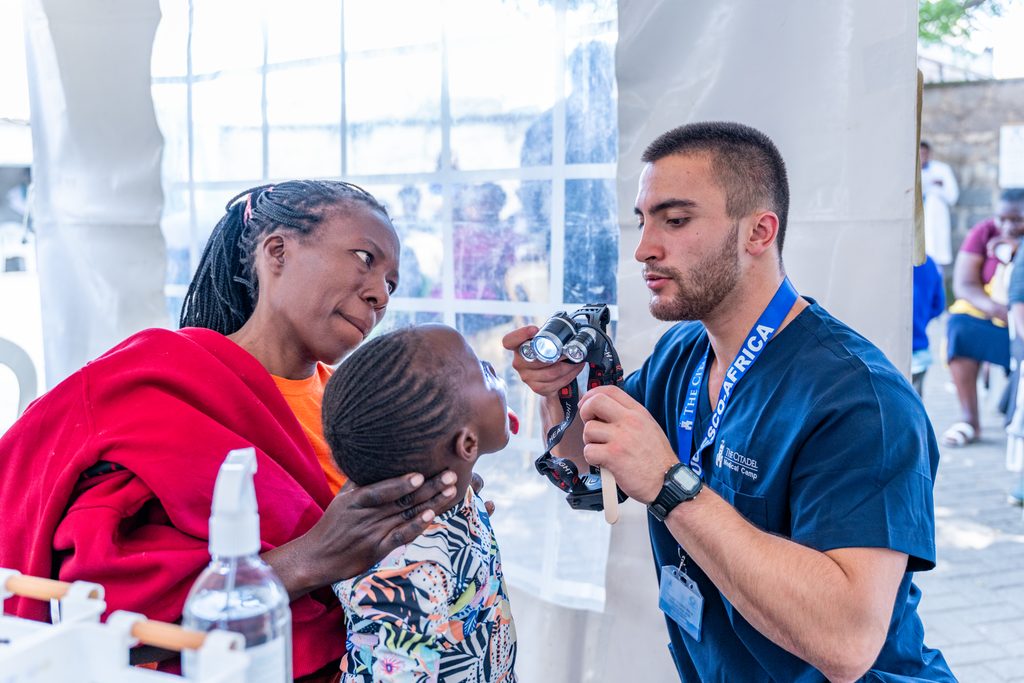
For Krome, the experience also offered a broader understanding of the circumstances that shape a person’s health.
Visiting homes and schools in Nairobi’s slums, she saw how people lived and experienced the warmth with which families welcomed the students into their homes.
The experience reinforced her interest in osteopathic medicine, which emphasizes a holistic approach to health and considers the connections between the body, mind and spirit.
“I think it’ll just help me to be a lot more open and just trying to consider all aspects of somebody’s life, not just maybe their symptoms or immediate medical diagnosis,” Krome said. “And just being able to interact with my patients and just be there for them in a human way, not just a doctor way.”
It’s a fitting next step for a girl who, at 6 years old, already knew she wanted to help people.
Now, with medical school ahead of her, Krome has a clearer picture of what that dream can look like.
For more information about the program, which is designed primarily for Pre-Health students but is open to all majors, visit this website to learn about all of The Citadel’s faculty-led study abroad programs. To schedule an advising session, please email studyabroad@citadel.edu.
 The Citadel in photos: Parents’ Weekend, Leadership Day and more from October 2026
 The Citadel Regimental Pipe Band earns regional championship at Stone Mountain Highland Games and Scottish Festival
 The Citadel puts leadership into action across campus and Charleston