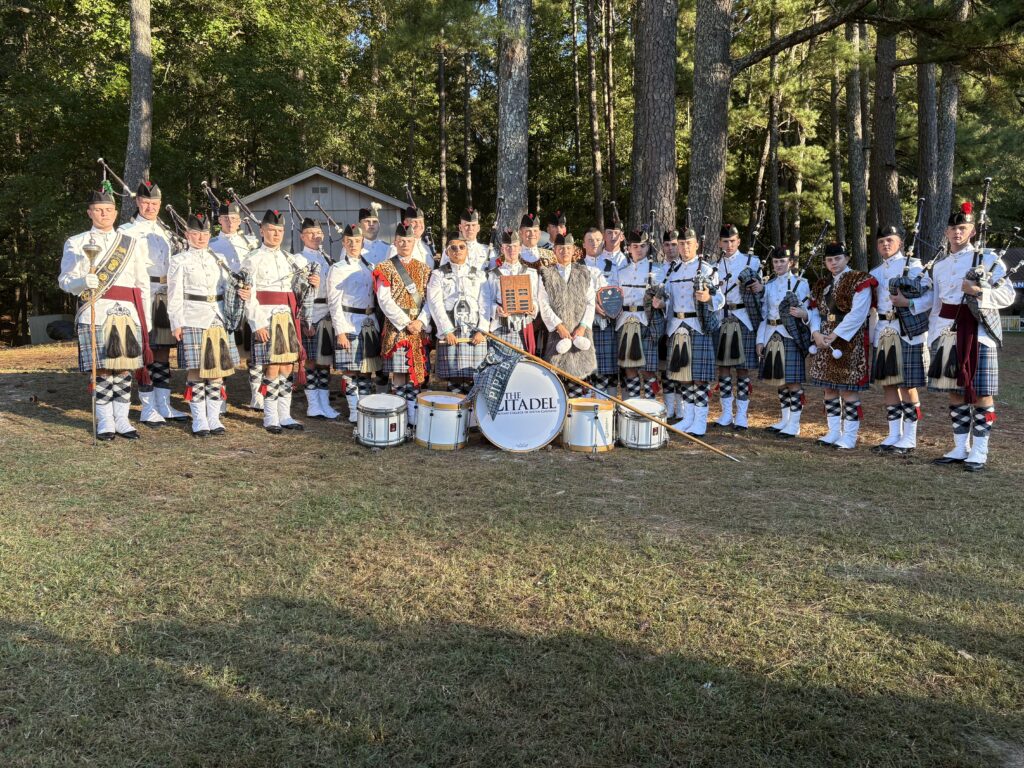
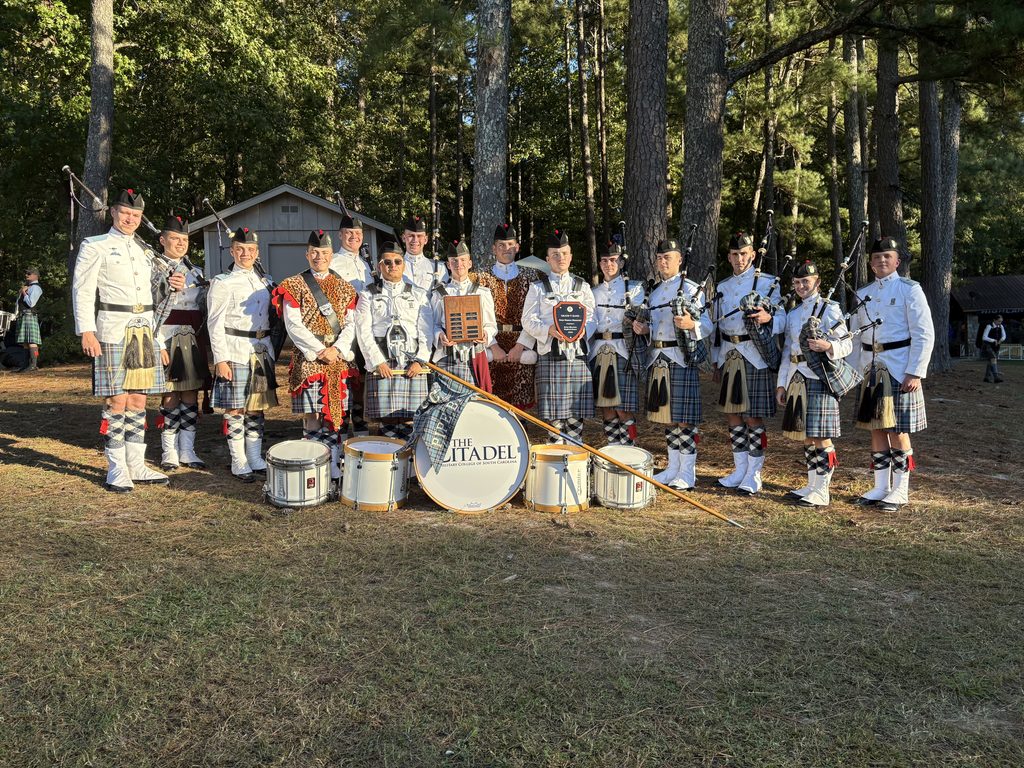
When The Citadel Regimental Pipe Band was named the Eastern United States Pipe Band Association’s Southern Branch Champions for 2026, Cadet Jeb Bruner marveled at how far the group has come.
Bruner, ’27, serves as the Pipe Major for the entire Regimental Pipe Band. He joined the band as a freshman in August 2023.
In those three years since, he said he has watched its competitive band program grow, mature and succeed.
At its first competition of this academic year, the beginner-level Grade 5 band claimed a regional championship title at the Stone Mountain Highland Games and Scottish Festival, while the more advanced Grade 4 band earned third place overall and two first-place finishes in piping.
“It’s amazing. It’s just remarkable,” Bruner said in the days after the competition in Stone Mountain, Georgia. “Everybody’s been putting in the work.”
The Citadel Pipe Band won first place at the Stone Mountain Highland Games and Scottish Festival, beating out 16 other bands for the title. The crowd erupted when the announcement came over the speaker system.
The championship win was particularly meaningful because the Grade 5 band is made up primarily of beginner pipers, most of whom started learning to play the bagpipes as freshmen, said Regimental Pipe Band Director Samuel Dillahey, ’01.
“Yet they were able to pull out the victory against bands who are able to practice all year and don’t graduate a quarter of their membership each year,” Dillahey said.
“Since returning to campus in mid-August, both competitive units have been focused on preparing not only for this contest but the many other events both on and off campus that we are heavily involved with,” he said, adding, “I couldn’t be more proud of all of the members of the Pipe Band and how they always represent The Citadel with class.”
The Regimental Band and Pipes functions as a single cadet company at The Citadel, consisting of two parts – the Regimental Band and the Regimental Pipe Band. Both units consist of a drum major and a number of musicians.
While each unit can perform independently, they often come together to support the Corps of Cadets, the community and the nation.
Bruner said the differences between one band grade and another can be so nuanced that a general audience may not even notice. However, there are three main categories by which piping bands are judged: unison, intonation and unit ensemble.
“We want to sound like one bagpipe. We don’t want to sound like 10 bagpipes that all happen to be playing together,” he said.
One other consideration when it comes to the bagpipes, he said, is the reality of what it takes to do it well.
“You’re doing like four different things at one time. You know, you’re having to march around, you’re having to control your breathing and your airflow through your bag, and you’re having to play your instrument at the same time. And those are all completely independent of one another,” he said. “The amount of you know skill and coordination that it takes to be able to do that — and look like you know what you’re doing — is a little bit higher than it is for for most instruments.”
The distinctive sound of bagpipes first graced The Citadel in 1955, and their resonant tones have become a celebrated tradition ever since.
The Citadel Regimental Pipe Band, one of the college’s most iconic attractions, features a drum major, skilled pipers and drummers. Formed alongside the college’s band in 1955, the Pipe Band, led by the kilted drum major adorned with a Highland feather bonnet, serves as the vibrant centerpiece of the Regimental Band and Pipes.
 The Citadel in photos: Parents’ Weekend, Leadership Day and more from October 2026
 The Citadel puts leadership into action across campus and Charleston
 Looking back at moments from Parents’ Weekend 2026 at The Citadel