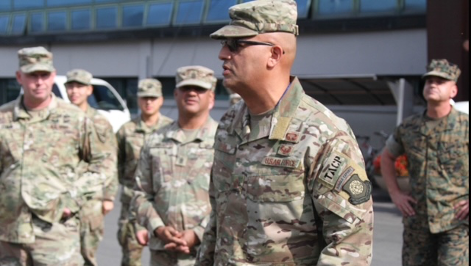
Photo: Chief Peña addressing Airmen and Marines at the South Korea Combined SEL Conference, August 2017
This article was originally written for Dr. Lauren Rule Maxwell’s Honors Advanced Writing Course.
By William Mosley, ’27
Chief Master Sergeant (Ret.) Victor A. Peña doesn’t measure leadership by rank, ribbons or medals, but instead by the people he shaped and impacted in over 30 years in the U.S. Air Force’s Tactical Air Control Party (TACP) program. For him, success was never the goal – significance was.
“You’ve already been successful,” he says. “Now choose to be significant.”
Chief Peña embodies this at The Citadel, where he serves as the only enlisted TAC Officer, carrying forward a lifetime of leadership and lessons forged in the heat of combat and the brotherhood of service. His mentoring extends beyond just advising, to forging future leaders, the very men and women this country needs.
Born and raised in Long Branch, New Jersey, Chief Peña didn’t plan on joining the Air Force, “until I got into a fight with my Puerto Rican dad – and that’s someone you don’t get into a fight with.”
When his father cut off his college tuition payments, he was forced to make a decision and chose to enlist. While the recruiter promised quick service and a return home to New Jersey, he quickly found himself under the sweltering heat of Hurlburt Field, Florida, fighting to earn the title of TACP, one of the Air Force’s elite ground operators tasked with coordinating air support in combat zones.
“From New Jersey to Texas – where I think the devil has a home,” he jokes. “I’ve never been that hot in my life, except in the desert.”
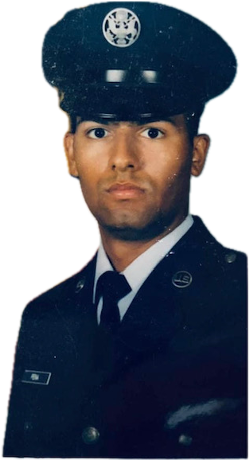
Over the next three decades, he would serve across the globe in operations including Enduring Freedom, Iraqi Freedom and New Dawn. Chief Peña rose quickly through the ranks, culminating as the Squadron Superintendent for the 15th Air Support Operations Squadron at Fort Stewart, Georgia, where he learned that true leaders don’t focus on control, but rather care for their soldiers.
Before 9/11, Chief Peña recalls the military being incredibly competitive and career-driven, a place where schools, training and badges set you apart for promotion and success. After the attacks, however, everything changed.
“We weren’t after vengeance,” he says. “We were after a reckoning.”
Such a distinction became the defining characteristic for an entire generation. “9/11 made it about us – not me, but we. It galvanized us all, making America one team again. That’s something we forget sometimes, being so busy with the hyphens – Puerto Rican-American, Irish-American. Why not just American?”
Such a unity is what Chief Peña believes makes the military an unparalleled organization.
“In service, if you dropped a grenade in a room,” he says, choking with emotion, “everyone would jump on it for you. That’s what you miss.”
Chief Peña’s combat experience honed his focus on what truly mattered: “The color of the drapes in the meeting room doesn’t matter anymore; the only thing that matters is that your people are trained, taken care of and understand the mission at hand.”
Leading by example and embodying the standard, he made sure his gear was always ready, radios pristine and vehicles spotless. Advancing into leadership positions, however, his focus shifted outward to his men, “When you’re young, you care if your boots are shined. But when you’re a leader, you care if your team’s boots are shined.” He says, “It’s no longer about you – it’s about them.”
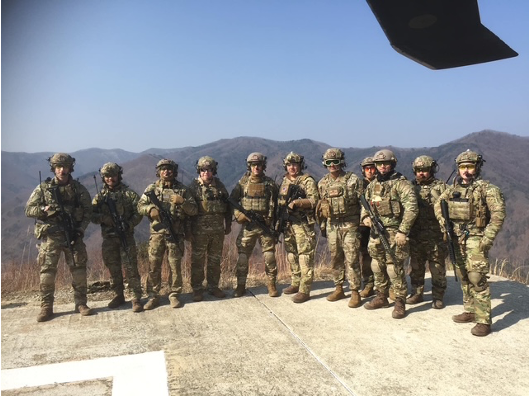
Every leader must understand their “why,” in a lesson Chief Peña breaks down into three critical pillars: who hurt you, who helped you and who healed you.
“The first ‘why’ is who hurt you – because that changes you,” Chief explained, “The second is who helped you – the people who taught you, lifted you up and helped you. The third is who healed you – for me, that’s Christ. But for others, it might be something else. You just have to find it.”
Such a deep spiritual grounding helped him through dark times while deployed, but also against the fight he brought back home.
“I used to wake up reaching for my body armor, helmet and gun,” he admitted. “So, I put my dog’s bed next to mine. When I’d wake up, I’d see him there – warm, breathing – and I’d know I was home.”
He still catches himself changing lanes under overpasses – a reflex from driving in combat convoys to avoid the dropping of IEDS (Improvised Explosive Devices) from above.
“That’s when you have to stop and ask yourself, ‘Where are you? Slow down.’”
For Chief Peña, healing comes through thanksgiving and gratitude.
“Man, I’m no hero, although I walk with some,” he says quietly. “I’m blessed in life – so blessed – because some of our brothers aren’t.”
Chief Peña utilizes a leadership style he calls bold leadership.
“The Air Force uses the term ‘intrusive leadership.’ But ‘intrusive’ means I don’t have a relationship with you. ‘Bold’ means I do – and I care enough to call you out when something’s going to derail your life.”
He laughs, recalling how younger airmen in his unit would buy fast motorcycles or corvettes after deployments, chasing the adrenaline of jumping out of helicopters with rounds flying overhead.
“I’d ask them: ‘How fast are you riding that thing – and why?’” Coupled with a pause, it really sinks in. “You can enjoy life, but you have to have people around you who will grab you and check you when you’re being reckless. That’s leadership.”
After more than 30 years of service and making the decision to retire, Chief Peña knew exactly who he was – and who he wasn’t.
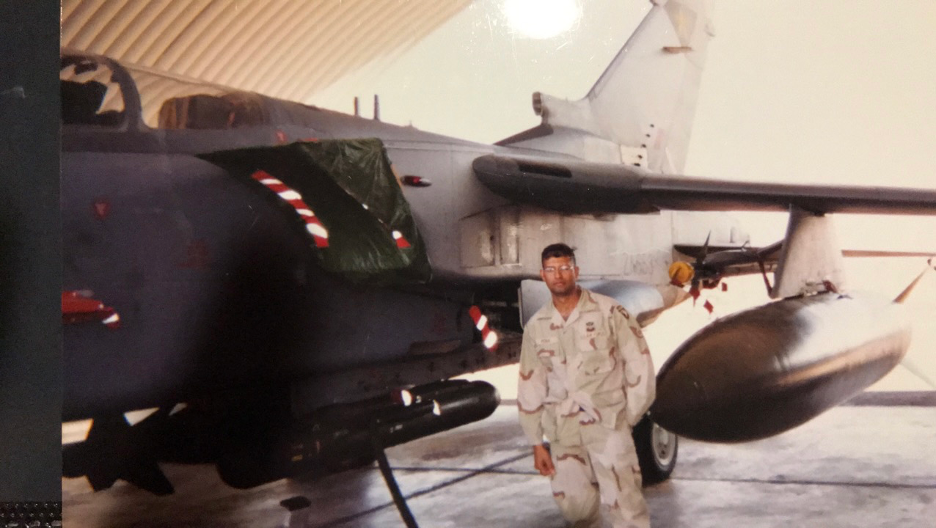
“Some folks can’t let go of the rank,” he says. “They still have to be called Chief. I get it. But my wife made sure I remembered – I wasn’t a Chief at home.” Transitioning into the civilian world, he found purpose and a way to impact new generations at The Citadel, serving as a TAC Officer for Victor Company. “I chose here to be significant,” he says. “I’ve made six chiefs in the Air Force, and I’m still making leaders here every day.”
He’s proud of the legacy being built here – mentoring future officers with the very pillars of directness, compassion, and wisdom that defined his military career and exceptional leadership.
“Advising the next generation of leaders,” he says, quoting The Citadel’s motto. “It’s a great line. But I’m not here to advise you. I’m here to forge you. Forging means heat, pressure, and hammering – that’s how you make steel.” To sum up his leadership philosophy, Chief Peña broke it down into five crucial phases: compassion, character, commitment, communication and charisma.
“The first two – compassion and character – are the true foundation,” he explained. “If you have those, you can lead anywhere, in business, the military, and in life, because it’s all the same. Real leadership is built on caring and doing what’s right.” The other three, he says, come naturally when the foundation is strong. “Commitment means showing up. Communication means saying what needs to be said. And charisma – well, I think I’ve got that one,” he says with a chuckle. “The guys say I’ve got this whole ‘rizz’ thing down.”
Chief Peña’s impact isn’t measured in accolades or awards, but in people – the soldiers he’s mentored, cadets he’s guided and the lives he’s touched.
“To this day, I have colonels who send me bourbon at Christmas,” he says with a smile. “That’s legacy. That’s significant.” When asked what his hope is for cadets, his answer is simple: success with meaning. “I want to look up 10 years from now, smoking a good cigar, drinking good bourbon and probably playing some bad golf, to see your name on TV for doing something great,” he says. “If you mention me, that’s a bonus, but what really matters is that you’re successful – that you’re better.”
At The Citadel, Chief Peña doesn’t just see students, but instead, the future – forged by discipline, faith and fire.
“Leadership,” he says, “is about compassion and character. If you get those right, everything else will follow.”
Cadet William Mosley is the Regimental Provost Marshal NCO for the South Carolina Corps of Cadets, from San Antonio, Texas, with a double major in Political Science and Intelligence and Security Studies. Additionally, Mosley is a member of The Citadel’s Distinguished Scholar Program and has a four-year Army ROTC scholarship. Upon graduating, he intends to commission into the U.S. Army as a 2nd Lieutenant and Armor Officer.
 Photos from campus: March in review
 Upcoming News from The Citadel – April 2026
 Honoring The Citadel’s 2026 Palmetto Medal recipients