By Andrew Granger, CGC ’26
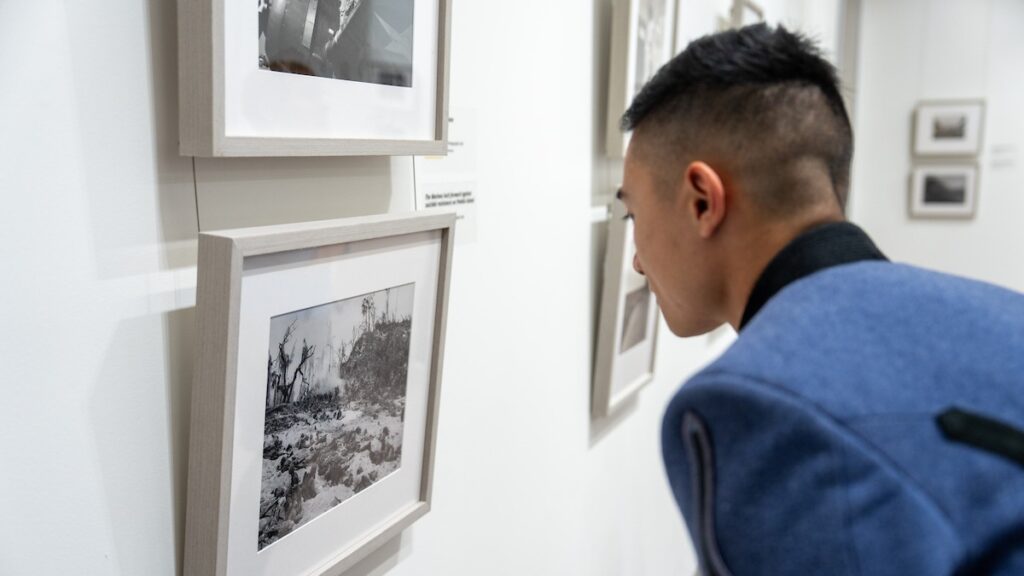
In “All Hands on Deck: Edward Steichen and the WWII Naval Photographic Unit,” the newest exhibition in the Moore Art Gallery, visitors are invited into a up-close view of World War II told through the eyes of one of the 20th century’s most influential photographers and his team from inside the U.S. Navy.
The black-and-white photographs immediately impress on their viewers the life of sailors and aviators during WWII: the curve of a carrier deck in the sun, sailors resting in their cots, Marines moving through scorched terrain, a Japanese torpedo bomber plane bursting into flame and shrapnel as it is hit by a 40 mm shell launched from the USS Yorktown. These are the kinds of images that slow down the viewer and pull them into the exhibit. The crisp details, dramatic compositions, and unusual perspectives offer multiple levels of interaction and information.
Edward Steichen understood how a single image could carry potent emotion and meaning. Having served in WWI in the Army Signal Corps in reconnaissance photography, Steichen was best known for his career in fashion photography, shaping public perception of glamour at Conde Nast publications like Vogue and Vanity Fair and as a curator of photography at the Museum of Modern Art. At 62, despite his age, he was recruited as a lieutenant commander in the Navy to produce images that would draw attention to the Navy’s aviation program. What began as promotional work didn’t stay that way.
The exhibition makes apparent the tone Steichen explored through the medium of his camera. His instruction to his team was clear.
“Don’t photograph the war, photograph the man… Photograph the sailor,” Steichen told his crew.
That philosophy, when practiced, became meticulous and efficient. Photographers sent their film back to Steichen; he had it developed and printed to professional standards; and then, with a grease pencil, he marked prints with instructions on how the images should be cropped and reproduced for major news outlets.
One of the compelling parts of the exhibit is getting to see that process. Visitors can see the prints with notes made by Steichen before sending in for editing, feeling the process of editorial choice: a little tighter on the face, deepen the shadows, pull the eye toward the line of motion.
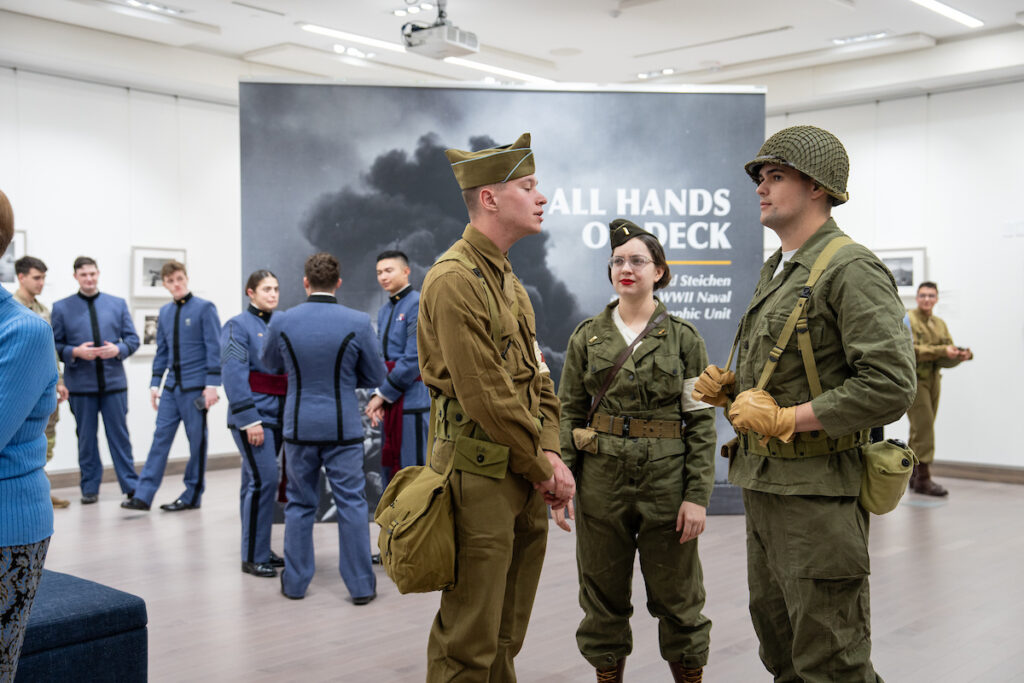
In the Charleston City Paper, writer Maura Hogan described how Steichen’s wax-pencil interventions reveal “a rare look under the hood” of this visual archive, and how the exhibition pairs images to highlight Steichen’s compositional brilliance from the beginning to the end of a photographs’ experience.
The story is not only about one celebrated name. Navy regulations generally prevented individual photographer credit, but records identify members of the unit whose work appears in this exhibit: Charles Kerlee, Horace Bristol, Charles Jacobs, Victor Jorgenson, Wayne Miller and Dwight Long, among others. The exhibition draws from multiple sources to tell that broader story — including materials from Patriots Point Naval and Maritime Museum, and a recent gift from MoMA to Patriots Point that helped put additional Steichen-related holdings into public view.
Curated by Tiffany Reed Silverman, director of fine arts at The Citadel, the exhibit also highlights how Steichen’s influence extended beyond the war years.
“Steichen and his unit expertly captured stunning moments of history that bring into sharp focus the bond between generations of those who serve,” said Silverman. “With deep appreciation to Patriots Point, this exhibit has allowed our cadets to look into the faces of the past and reflect upon their own present.”
For Charleston, and for campus visitors who may be seeing these stories for the first time, “All Hands on Deck” offers something rare: a wartime record that doesn’t flatten or simplify its focuses. It keeps pulling you back to the individuals – the sailor on watch, the pilot readying for flight, the crews working at the edge of danger – and asks you to look long and to recognize a shared humanity.
Allison Hunt, Executive Director at Patriots Point, is excited to help display these works to The Citadel community.
“It’s incredibly meaningful for us to be able to bring these remarkable artifacts from Patriots Point to The Citadel campus and share them with a new audience. These photographs by Edward Steichen and his Naval Photographic Unit are more than images – they are powerful, firsthand witnesses to defining moments of World War II,” said Hunt. “Having them on display here allows students, faculty and visitors to connect directly with the courage, sacrifice and humanity captured through the lens of those who were there.”
The exhibition is free and open to the public, on view through May 8 during gallery hours Monday –Friday, 10 a.m. – 3 p.m., at the Moore Art Gallery in Capers Hall on The Citadel’s campus.
Andrew Granger of Atlanta, Georgia earned his bachelor’s degree from The Virginia Military Institute in English, Rhetoric and Humanistic Studies. He is currently working as a graduate assistant in the Office of Communications and Marketing while pursuing a master’s degree in Project Management.
 ‘I will be relentless’: Gen. Frank McKenzie inaugurated as The Citadel’s 21st president
 The Citadel leads South Carolina in TIME’s inaugural ‘America’s Best Colleges’ ranking
 The Citadel in photos: Matriculation Day, cadet life and more from August 2026